Project Overview
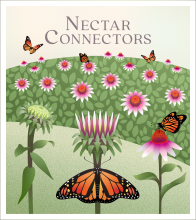
We are seeking observers to learn about the flowering timing of nectar sources for monarchs and other pollinators! Pollinators are an essential part of our environment - they ensure the reproduction of 85% of the world's flowering plants, and over two-thirds of our crop species. Many threats, including habitat loss and use of pesticides, threaten these pollinators.
One of the best-known butterlfies in North America is the monarch butterfly. Monarchs are renowned for their complex life cycle, which takes them on the longest-known migration distance for insects.
Due to this complex, long-distance migration, the dietary needs of monarchs are complex. The nectar that they rely on to fuel their flight comes from a diverse suite of flowering species that occur across a large geographic area. Changes to these food sources, through habitat loss, pesticide use, or climate change, can be costly to monarch populations, as well as to the many other pollinators that rely on these same species for their dietary needs.
Sign up for Nectar Connectors messages
You will receive messages full of findings, observation tips, and campaign-specific opportunities. Don't miss out!
Phenophase photo guides
Download phenophase photo guides to help you with identiying flowering of a subset of these species, available on the New York Phenology Project website.
See what we are learning from this campaign
How to Participate
Join Nature's Notebook and select one or more wildflowers from the list to track. Observe flowering ideally 2–3 times per week during spring, summer, and fall, and log your data in Nature's Notebook. Need help getting started? Take the Observer Certification Course.
Nectar Connectors Species
This campaign includes 87 species in 38 genera:
- Acer (1 species)
- Asclepias (24 species)
- Baccharis (1 species)
- Callicarpa (1 species)
- Calyptocarpus (1 species)
- Cephalanthus (1 species)
- Cercis (1 species)
- Cirsium (4 species)
- Conoclinium (2 species)
- Coreopsis (1 species)
- Dalea (1 species)
- Echinacea (1 species)
- Ericameria (1 species)
- Eryngium (1 species)
- Eutrochium (2 species)
- Gaillardia (1 species)
- Helianthus (2 species)
- Lantana (1 species)
- Liatris (3 species)
- Lobelia (1 species)
- Lonicera (1 species)
- Lupinus (7 species)
- Malvaviscus (1 species)
- Monarda (3 species)
- Oenothera (1 species)
- Passiflora (1 species)
- Phyla (1 species)
- Plectocephalus (1 species)
- Ratibida (1 species)
- Rudbeckia (1 species)
- Salix (1 species)
- Salvia (1 species)
- Sambucus (3 species)
- Solidago (7 species)
- Symphyotrichum (2 species)
- Verbesina (2 species)
- Vernonia (1 species)
- Zizia (1 species)
Top 10 Contributing Programs
Local Phenology Programs with the most observation records submitted this year.
| # | Program | Observations |
|---|---|---|
| 1 | Great Smoky Mountains NP | 12,839 |
| 2 | Earthwise Aware | 11,535 |
| 3 | Mohonk Preserve | 10,091 |
| 4 | Bowmans Hill Wildflower Preserve Phenology Project | 7,233 |
| 5 | Olbrich Botanical Gardens | 6,027 |
| 6 | UVM Phenology | 5,098 |
| 7 | Appalachian Mountain Club | 4,664 |
| 8 | Weir Farm NHP | 4,477 |
| 9 | Salisbury University | 4,340 |
| 10 | Wells Reserve | 3,948 |
Earn your Nectar Connectors badge
See it on your Observation Deck.
